
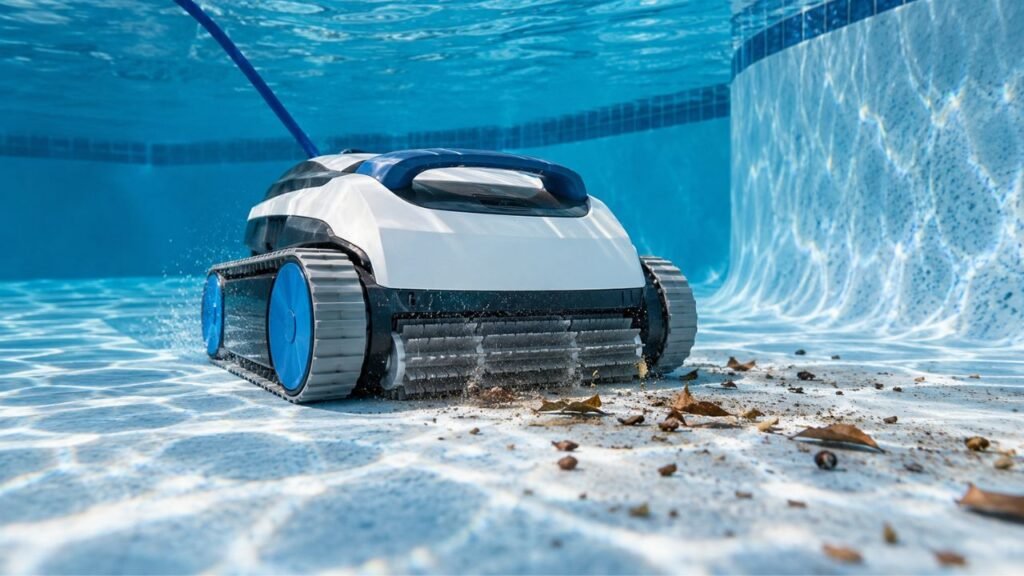
A robotic pool cleaner works independently using its own motor, pump, brushes, filter, and navigation system. It moves across pool surfaces, loosens dirt, vacuums debris, traps it internally, and returns filtered water to the pool.
That sounds simple, but several systems work together during every cleaning cycle. Below, I’ll explain how robotic pool cleaners move, scrub, filter, navigate, climb walls, and handle different types of debris.
Key Takeaways
- Robotic pool cleaners work separately from the main pool filtration system.
- Internal motors power movement, suction, brushes, and onboard electronics.
- Rotating brushes loosen dirt, algae, and debris from pool surfaces.
- An internal pump pulls water and debris through the cleaner.
- A filter basket or cartridge traps debris inside the robot.
- Navigation systems range from simple patterns to advanced sensor-based routing.
- Wall and waterline cleaning depend on the specific cleaner model.
- Corded robots use external power, while cordless models use batteries.
What Is a Robotic Pool Cleaner?
A robotic pool cleaner is an automatic machine designed to clean swimming pools with minimal help from you.
Unlike many traditional automatic cleaners, a pool robot carries most of its cleaning equipment onboard. It usually has its own drive motor, water pump, brushes, filter, and electronic controller.
That means it normally does not rely on your pool pump to create suction.
You simply place the cleaner inside the pool and start a cleaning cycle. The machine then travels across supported surfaces while collecting debris.
Depending on the model, it may clean the floor only. More capable robots can also climb walls and scrub the waterline.
Some models even let you choose different cleaning modes through onboard controls or a mobile app.
The important thing to remember is that “robotic” does not mean every cleaner works identically. Navigation, filtration, climbing ability, and cleaning coverage can vary significantly between models.
How Does a Robotic Pool Cleaner Work Step by Step?
Although several systems operate simultaneously, the basic cleaning process follows a predictable sequence. Knowing these steps makes the technology much easier to understand.
- The cleaner receives power: A corded model receives electricity through its power system. Cordless models receive power from an internal rechargeable battery.
- The drive system starts moving: Motors turn the wheels or tracks and move the cleaner across the pool surface.
- The brushes loosen debris: Rotating brushes scrub dirt, algae film, and other material attached to the surface.
- The pump pulls water inside: An internal impeller creates water flow through the cleaner’s intake.
- Debris enters the filter: Water carries leaves, hair, sand, and dirt into an internal basket or cartridge.
- The filter traps debris: Solid material remains inside while filtered water passes through.
- Water returns to the pool: The cleaner releases the filtered water through its discharge outlets.
- Navigation guides movement: Sensors or programmed movement determine where the cleaner travels next.
- The cycle finishes: Once the programmed cycle ends, you remove the cleaner and empty its filter.
These actions usually happen continuously rather than one after another. The robot can scrub, vacuum, filter, and move at the same time.
What Parts Make a Robotic Pool Cleaner Work?
Several components must work together for a robotic pool cleaner to operate correctly. Each component handles a different part of the cleaning process.
| Component | What It Does | Why It Matters |
| Power system | Supplies electricity | Runs motors, pump, and electronics |
| Drive motor | Turns wheels or tracks | Moves the robot around the pool |
| Pump and impeller | Moves water through the cleaner | Creates the vacuuming action |
| Scrubbing brushes | Loosen attached dirt | Improves surface cleaning |
| Filter basket or cartridge | Holds collected debris | Prevents debris returning immediately |
| Wheels or tracks | Provide movement and traction | Help the robot cross pool surfaces |
| Sensors | Detect movement or surroundings | Improve navigation and coverage |
| Controller | Manages cleaning functions | Coordinates movement and cleaning cycles |
The quality of these components affects how well the cleaner performs.
A powerful pump alone does not guarantee better cleaning. Navigation, filtration, brush contact, and traction matter just as much.
How Do Robotic Pool Cleaners Know Where to Go?
Navigation is one of the biggest differences between basic and advanced robotic pool cleaners. Some machines follow simple movement patterns, while others use sensors to clean more systematically.
Basic or Random-Pattern Navigation
Entry-level cleaners may use relatively simple directional movement.
The robot travels until it reaches a wall or another obstacle. It then changes direction and continues moving.
Over time, repeated passes can cover much of the pool.
However, this method may clean some areas repeatedly while missing others. Irregular shapes, tight corners, and shelves can make coverage less consistent.
A long cleaning cycle does not automatically mean complete coverage.
Sensor-Based and Systematic Navigation
More advanced cleaners can use sensors to track orientation and movement.
Depending on the model, these systems may include gyroscopes, accelerometers, wall detection, or other positioning sensors.
This allows the cleaner to travel in more organized patterns.
Instead of repeatedly wandering through the same area, it can make more deliberate passes across the pool.
That generally helps reduce unnecessary overlap and missed sections.
Mapping and Advanced Navigation
Some premium robotic cleaners use more sophisticated navigation technologies.
These systems may combine mapping algorithms with infrared sensors, ultrasonic sensing, cameras, or other environmental information.
The cleaner can use that information to identify pool boundaries and plan more efficient routes.
Certain systems may also recognize obstacles or concentrate cleaning in specific areas.
However, you should not assume every cleaner advertised as “smart” creates a detailed pool map.
Manufacturers use the term differently.
Check the actual navigation specifications when comparing robotic cleaners.
How Do Robotic Pool Cleaners Scrub and Vacuum Debris?
A robotic pool cleaner does more than simply suck loose debris from the floor. Brushes, water flow, and filtration work together throughout the cleaning cycle.
Scrubbing Brushes Loosen Stuck-On Dirt
Some pool debris is easy to vacuum.
Leaves, insects, and loose sand may already rest freely on the pool floor.
Other material sticks tightly to pool surfaces.
Algae film, body oils, dirt, and biofilm can cling to plaster, vinyl, fiberglass, and tile.
That is where rotating brushes become important.
The brushes physically agitate the surface and loosen attached material. Once loosened, the debris becomes easier for the cleaner to collect.
Brush materials and designs vary between models.
Some use rubber brushes, while others use textured or more aggressive designs. The proper brush depends partly on your pool surface.
The Pump Creates Water Flow and Suction
Inside the cleaner, an electric motor drives an impeller or pump.
The pump moves water through the intake opening.
As water enters, it carries loosened debris into the cleaner.
This produces the vacuuming effect people normally associate with a robotic pool cleaner.
Suction performance depends on more than motor strength.
Intake design, pump flow, filter condition, and debris size all influence performance.
A heavily clogged filter can restrict water flow and reduce cleaning effectiveness.
The Filter Captures the Debris
After entering the cleaner, water moves through an internal filter.
The filter may be a basket, cartridge, mesh panel, or another reusable filtering system.
Large debris usually includes:
- Leaves
- Hair
- Insects
- Small twigs
- Larger dirt particles
Finer filters may also collect:
- Sand
- Silt
- Pollen
- Fine dust
- Smaller suspended particles
Some manufacturers provide filtration ratings measured in microns.
A smaller micron rating generally indicates finer filtration. However, filtration specifications vary considerably between cleaners.
You should therefore compare the actual filter specification instead of assuming every robot captures the same particle sizes.
How Do Robotic Pool Cleaners Climb Walls?
A wall-climbing robotic pool cleaner uses traction, motor power, and water movement to stay against vertical pool surfaces.
Tracks or wheels grip the wall while the drive system moves upward. At the same time, water flow through the cleaner helps maintain contact with the surface.
The robot can then continue scrubbing as it climbs.
Pool surface also affects climbing performance.
A cleaner may behave differently on smooth fiberglass than textured plaster. Curved transitions between the floor and wall can also influence traction.
Not every robotic pool cleaner climbs walls.
Some models are specifically designed for floor cleaning only. Always check the listed cleaning coverage before buying.
Steps, benches, tanning ledges, and unusual pool shapes can also challenge some wall-climbing robots.
How Do Robotic Pool Cleaners Clean the Waterline?
Waterline-capable robotic cleaners travel up the pool wall until they reach the surface area. Their brushes then scrub the band where water meets the pool wall.
This area often collects:
- Body oils
- Sunscreen residue
- Pollen
- Dust
- Organic residue
- Fine surface grime
That buildup can create a noticeable ring around the pool.
Some robots move sideways along the waterline. Others briefly scrub the area before moving elsewhere.
Waterline cleaning can make a major visual difference, especially around tile.
However, waterline cleaning is not available on every robotic cleaner.
Floor-only or basic wall-climbing robots may never properly scrub this area.
Corded vs Cordless Robotic Pool Cleaners: How Does the Power System Differ?
Robotic pool cleaners need electricity to operate their motors, pump, and electronics. That electricity normally comes from either an external power source or a rechargeable battery.
| Feature | Corded Robotic Cleaner | Cordless Robotic Cleaner |
| Power source | External power supply | Rechargeable battery |
| Floating cable | Yes | No |
| Battery charging | No | Yes |
| Runtime | Usually cycle-based | Limited by battery capacity |
| Cable management | Required | Not required |
| Deployment | Slightly more setup | Usually quick and simple |
| Best consideration | Longer repeated cleaning | Cable-free convenience |
Neither design is automatically better for every pool.
Corded Robotic Pool Cleaners
Corded cleaners receive continuous power through a floating cable connected to their external power system.
Because battery capacity does not limit them, they work well for longer cleaning cycles.
The downside is cable management.
Long cables can occasionally twist or interfere with movement if they are not handled correctly.
Some modern corded designs include features intended to reduce cable tangling.
Cordless Robotic Pool Cleaners
Cordless cleaners use rechargeable internal batteries.
There is no power cable trailing behind the cleaner during operation.
That makes placing and removing the robot relatively convenient.
However, cleaning time depends on available battery capacity.
Once the battery becomes depleted, the cleaner must be recharged before another complete cycle.
For larger pools, make sure the rated runtime comfortably matches the expected cleaning time.
What Does a Robotic Pool Cleaner Actually Clean?
Robotic pool cleaners can handle several common types of pool debris. Exact cleaning ability depends on the brush system, filter, suction, navigation, and pool design.
Depending on the model, a robot may clean:
- Pool floors
- Pool walls
- Waterlines
- Loose leaves
- Hair
- Insects
- Dirt
- Sand
- Pollen
- Fine sediment
- Loosened algae
- Organic debris
Debris type matters when judging performance.
A cleaner built around a large debris basket may handle leaves effectively. Another model with finer filtration may perform better against sand and fine dust.
Some premium cleaners combine both capabilities with multi-layer filtration.
Coverage matters too.
A cleaner can have excellent suction but still leave dirt behind if its navigation never reaches certain areas.
That is why overall cleaning performance depends on the entire system.
What Can a Robotic Pool Cleaner Not Do?
Robotic pool cleaners can reduce manual cleaning considerably, but they cannot handle every part of pool maintenance.
A robotic cleaner generally cannot:
- Automatically balance your pool chemistry
- Replace chlorine or another sanitizer
- Replace normal water circulation
- Guarantee perfect cleaning around every step
- Reach every narrow corner
- Handle unlimited amounts of large debris
- Clean the waterline unless designed for it
- Climb walls unless the model supports wall cleaning
- Remove stains that require chemical treatment
- Correct algae problems caused by poor water chemistry
This distinction matters.
A pool robot removes physical debris from pool surfaces and water passing through the cleaner.
It does not disinfect the pool.
If algae keeps returning, for example, brushing alone may not solve the underlying water chemistry problem.
You still need proper circulation, sanitizer levels, filtration, and routine pool care.
What Determines How Well a Robotic Pool Cleaner Works?
Two robotic cleaners can operate using the same basic principle yet deliver very different results. Several factors determine how thoroughly a robot cleans.
Pool Size and Shape
Pool dimensions directly affect cleaning coverage.
A small rectangular pool creates a relatively simple navigation problem.
A large freeform pool can include:
- Curved walls
- Deep ends
- Shallow sections
- Steps
- Benches
- Tanning ledges
- Irregular corners
Navigation becomes increasingly important as pool geometry becomes more complicated.
Choose a cleaner rated for your pool dimensions.
Pool Surface
Different pools use different surface materials.
Common examples include:
- Plaster
- Concrete
- Gunite
- Fiberglass
- Vinyl liners
- Tile
Traction and brush contact can behave differently across these surfaces.
A cleaner that performs well on plaster may behave differently on smooth fiberglass.
Always confirm that the manufacturer supports your pool surface.
Navigation Quality
Good navigation helps the cleaner use its available runtime efficiently.
A cleaner that continually repeats one area may run for hours without achieving complete coverage.
More systematic navigation can reduce these unnecessary repeated passes.
That becomes especially important in larger or irregular pools.
Filter Type and Fineness
Not every filter is designed for identical debris.
A coarse basket may handle large leaves extremely well.
However, very fine sand or silt may require finer filtration.
If fine debris repeatedly passes through the cleaner, check whether a finer compatible filter is available.
Brush Design
Suction collects loose dirt, but brushes help remove attached material.
Effective brushes improve cleaning around algae film and stubborn surface debris.
Brush contact matters just as much as brush rotation.
If the cleaner loses traction, its brushes may not maintain proper surface contact.
Debris Load
A pool filled with storm debris creates different cleaning demands than lightly dusty water.
Heavy leaf loads can fill the basket quickly.
Once the basket becomes packed, water flow can decrease.
During unusually heavy debris conditions, you may need to empty the filter during a cleaning cycle.
Filter Condition
A dirty filter makes the pump work against greater resistance.
As airflow or water flow becomes restricted, suction performance can decrease.
That is why one of the easiest ways to maintain good cleaning performance is simply keeping the filter clean.
Robotic vs Suction vs Pressure Pool Cleaners
Robotic, suction-side, and pressure-side cleaners can all automate pool cleaning. However, they create cleaning power in very different ways.
| Feature | Robotic Cleaner | Suction-Side Cleaner | Pressure-Side Cleaner |
| Own motor | Yes | No | Usually not for primary water pressure |
| Own filter | Yes | Usually no | Often uses a debris bag |
| Uses main pool pump | Normally no | Yes | Yes |
| Active scrubbing | Common | Model dependent | Model dependent |
| Advanced navigation | Available | Usually limited | Usually limited |
| Wall cleaning | Model dependent | Model dependent | Model dependent |
| Waterline cleaning | Available on some models | Limited | Limited |
| Setup | Drop into pool | Connect to suction line | Connect to pressure return |
The biggest difference is independence.
A robotic cleaner creates its own movement, suction, and filtration.
A suction-side cleaner depends on water being pulled through your pool’s existing suction system.
A pressure-side cleaner uses pressurized return water and may require additional equipment on certain systems.
For homeowners mainly interested in independent automated cleaning, robotic cleaners usually provide the most self-contained approach.
Are Robotic Pool Cleaners Safe to Use?
Robotic pool cleaners are designed for underwater operation, but electricity and water always require careful handling. Follow the instructions supplied with your specific cleaner.
Important safety habits include:
- Use the electrical protection specified by the manufacturer.
- Use a properly protected outlet when required.
- Keep external power equipment positioned as instructed.
- Never use a damaged power cable.
- Inspect chargers and connectors regularly.
- Do not pull the cleaner using its electrical cable.
- Disconnect power before performing maintenance.
- Follow manufacturer instructions regarding swimmers during operation.
- Never modify the electrical system yourself.
- Avoid extension cords when the manufacturer prohibits them.
For corded cleaners, the external power supply remains outside the pool.
The cleaner itself receives power through a system designed for its underwater operation.
Cordless models remove the floating power cable, but charging equipment still needs proper care.
Always follow the individual manual rather than applying one safety rule to every brand.
How Do You Use a Robotic Pool Cleaner?
Most robotic pool cleaners are relatively straightforward to operate. Still, using one correctly helps improve cleaning coverage and equipment life.
- Inspect the cleaner: Check the filter, brushes, cable, or battery before starting.
- Empty the filter if necessary: Starting with a clean basket improves water flow.
- Place the robot in the pool: Lower it carefully using the recommended handle.
- Allow trapped air to escape: Some models need to settle completely underwater.
- Connect or activate the power: Plug in the corded system or start the cordless cleaner.
- Choose your cleaning mode: Select floor, wall, waterline, or complete cleaning when available.
- Let the cleaning cycle finish: Avoid repeatedly moving the cleaner manually.
- Remove the cleaner correctly: Use its handle instead of pulling the power cable.
- Allow water to drain: The cleaner becomes significantly lighter after draining.
- Empty and rinse the filter: Removing debris immediately helps maintain performance.
Check the manufacturer’s instructions because startup procedures can vary.
How Do You Maintain a Robotic Pool Cleaner?
Robotic pool cleaner maintenance is generally simple, but consistency matters. A few minutes after cleaning can prevent restricted flow, poor navigation, and premature wear.
After Each Cleaning Cycle
Remove the filter basket or cartridge after the robot finishes.
Empty leaves, dirt, hair, and other debris.
Rinse the filter thoroughly using clean water.
Check the intake for material that could block water flow.
You should also look for hair or string wrapped around moving components.
Keeping the filtration system clean helps the pump maintain proper water flow.
Periodic Maintenance
Every few cleaning cycles, inspect the rest of the cleaner carefully.
Check:
- Brushes
- Wheels
- Tracks
- Intake openings
- Impeller area
- Sensors
- Floating cable
- Battery contacts where applicable
Remove sand, hair, leaves, or other material caught around moving components.
If navigation suddenly becomes inconsistent, inspect sensor areas for dirt or buildup.
Worn brushes and tracks may eventually need replacement.
Proper Storage
Avoid throwing the cleaner beside the pool after every use.
Store it according to the manufacturer’s recommendations.
A shaded and reasonably dry location protects the cleaner from unnecessary heat and sun exposure.
Corded cleaners should have their cables stored without sharp bends.
Cordless models may also have battery-specific storage recommendations.
Following those instructions becomes especially important during the off-season.
Benefits of Robotic Pool Cleaners
Robotic cleaners have become popular because they automate one of the most repetitive parts of pool care.
Important benefits include:
- Less manual vacuuming
- Automatic pool floor cleaning
- Active surface scrubbing
- Independent onboard filtration
- Reduced debris reaching the main pool filter
- Wall cleaning on compatible models
- Waterline cleaning on capable models
- Programmable cleaning cycles
- Smart navigation on advanced models
- Cordless options for easier deployment
- Fine-particle filtration on suitable models
- Less dependence on the pool’s circulation equipment
The biggest benefit is convenience.
Instead of manually vacuuming the entire pool, you can let the robot handle routine surface cleaning while you focus on water chemistry and other maintenance.
Drawbacks of Robotic Pool Cleaners
Robotic pool cleaners also have limitations worth knowing before buying one.
Potential drawbacks include:
- Higher upfront purchase cost
- Filters still require manual cleaning
- Cord management on corded models
- Battery charging on cordless models
- Replacement parts can become expensive
- Larger units may feel heavy when full of water
- Some robots struggle with stairs
- Certain models cannot handle shallow shelves
- Wall climbing varies between models
- Navigation quality can vary considerably
- Repairs may require specialized parts or service
A more expensive cleaner is not automatically the best choice.
The right cleaner should match your pool’s size, surface, shape, and usual debris.
Are Robotic Pool Cleaners Worth It?
For many pool owners, a robotic cleaner is worth considering because it reduces routine brushing and vacuuming.
It can be especially useful if your pool regularly collects leaves, sand, pollen, insects, or other debris. A suitable robot can handle much of that maintenance automatically.
However, it should match your actual needs.
You may not need an expensive wall-mapping model for a small, simple above-ground pool. Likewise, a basic floor-only cleaner may feel frustrating in a large in-ground pool with curved walls and heavy debris.
Focus on pool compatibility before focusing on impressive feature lists.
Navigation, filtration, cleaning coverage, and serviceability usually matter more than unnecessary extras.
Final Words
Robotic pool cleaners work through a simple repeating process. They move, scrub, vacuum, filter, and navigate around your swimming pool.
Their internal pump pulls debris into an onboard filter while rotating brushes loosen material stuck to pool surfaces. Wheels or tracks provide movement, while sensors or programmed navigation guide the cleaning path.
The biggest differences between robotic cleaners are not the basic cleaning principle. They are navigation quality, filtration, wall climbing, waterline coverage, power design, and pool compatibility.
Once you understand those differences, comparing robotic pool cleaners becomes much easier. Instead of focusing only on marketing terms, you can look at how the machine actually cleans your particular pool.
Related FAQs About How Robotic Pool Cleaners Work
Do Robotic Pool Cleaners Use the Pool Pump?
No, true robotic pool cleaners normally use their own internal pump and filtration system. They operate independently from the pool’s main circulation pump during cleaning.
Do Robotic Pool Cleaners Really Map the Pool?
Some advanced robotic pool cleaners use sensors and software to create organized cleaning routes or map pool areas. Simpler models may use basic patterns without creating a detailed map.
Do Robotic Pool Cleaners Pick Up Algae?
Robotic cleaners can scrub and collect loosened algae from pool surfaces. However, they do not sanitize the water or replace proper chlorine levels and algae treatment.
Can Robotic Pool Cleaners Climb Walls?
Many robotic pool cleaners can climb walls using motor power, traction, and water flow. However, wall-climbing capability depends on the specific cleaner and pool surface.
Do Robotic Pool Cleaners Clean the Waterline?
Some advanced robotic cleaners can scrub the waterline after climbing the pool walls. Floor-only and some basic wall-cleaning models may not offer waterline cleaning.
Do Robotic Pool Cleaners Work in Above-Ground Pools?
Yes, many robotic cleaners are designed for above-ground pools. Check the recommended pool size, surface type, shape, and cleaning coverage before choosing one.
Can You Leave a Robotic Pool Cleaner in the Pool?
It is generally better to follow the manufacturer’s storage recommendations rather than leaving the cleaner submerged permanently. Removing it also makes filter cleaning and inspection easier.
How Long Does a Robotic Pool Cleaner Take?
Cleaning time varies depending on pool size, navigation, selected cleaning mode, and model. Many cleaners offer preset cycles rather than operating continuously.
How Often Should You Run a Robotic Pool Cleaner?
Cleaning frequency depends on debris, weather, swimming activity, and season. Heavily used pools or pools surrounded by trees may require more frequent robotic cleaning.
Do Robotic Pool Cleaners Replace the Pool Filter?
No. The robot’s onboard filter collects debris during cleaning, but your main filtration system still handles normal pool circulation and ongoing water filtration.
Do Robotic Pool Cleaners Work Without Wi-Fi?
Yes. Most robotic cleaners can perform basic cleaning without Wi-Fi. App connectivity normally provides additional scheduling, monitoring, or remote-control features rather than basic cleaning power.
Are Cordless Robotic Pool Cleaners as Effective as Corded Models?
They can be, but effectiveness depends on pump performance, filtration, navigation, battery runtime, and pool compatibility. Cordless versus corded design alone does not determine cleaning quality.

Craig Turner writes practical guides on robotic pool cleaners and outdoor maintenance equipment. His reviews focus on usability, reliability, and helping homeowners choose the right tools.